A Practical, Low-Risk Guide to Migrating Large Node.js Projects from CommonJS to ES Modules
Surprising fact: unflagged ESM support back in Node 12 (stable in Node 14), yet many large codebases still run a majority of code in CommonJS. If your organization is hesitating, an incremental, CI-driven approach can reduce migration risk while unlocking better tree-shaking, future-compatible packaging, and cleaner import semantics.

Why move to ES Modules now
ES Modules (ESM) are the modern JavaScript module standard. Benefits include static import syntax that enables deterministic dependency graphs, better tree-shaking for bundlers, and clearer signal for downstream consumers. A few quick data points to frame urgency:
- Node supported ESM unflagged starting in Node 12 and stabilized in Node 14, making ESM a production option for most modern runtimes.
- Stack Overflow's developer surveys consistently show JavaScript as the top-used language (~65% of respondents), meaning ecosystem momentum favors modern module patterns.
- The npm registry now contains well over a million packages — many library authors are publishing ESM-first builds, increasing interoperability pressure.
Moving now reduces future technical debt and opens optimizations in bundlers and runtimes. That said, large codebases need a low-risk, reversible plan.
Audit your codebase: where are the risks?
Before converting code, run an inventory and classify packages by risk:
- Entry points and CLIs — highest risk (affects startup behavior).
- Native addons or
require()-heavy modules — medium risk. - Internal libraries with few external consumers — low risk.
Useful tooling: dependency graph analyzers (depgraph/graphviz), madge, and workspace-aware tools (pnpm/yarn workspaces). Record Node and TypeScript versions: ESM support and loader behaviour differ between Node 12/14/16/18.
Planning an incremental strategy
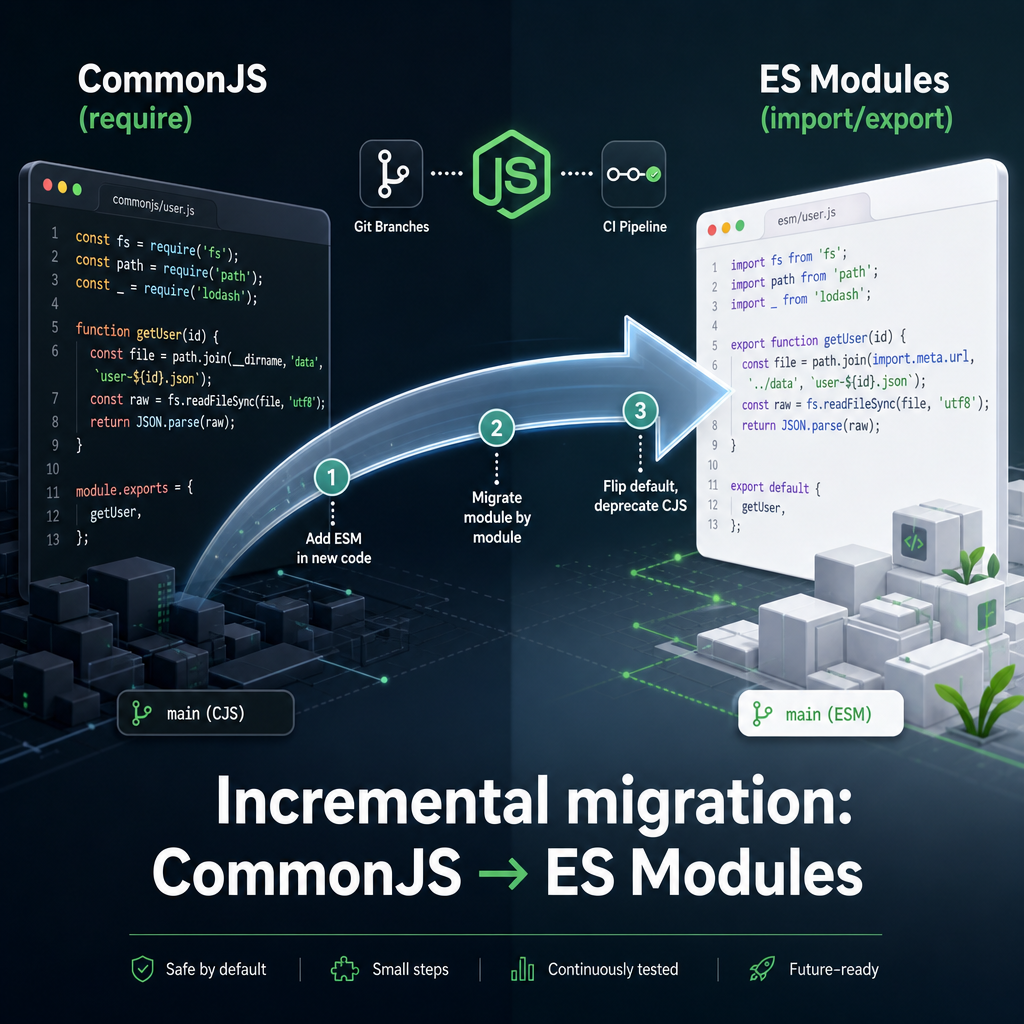
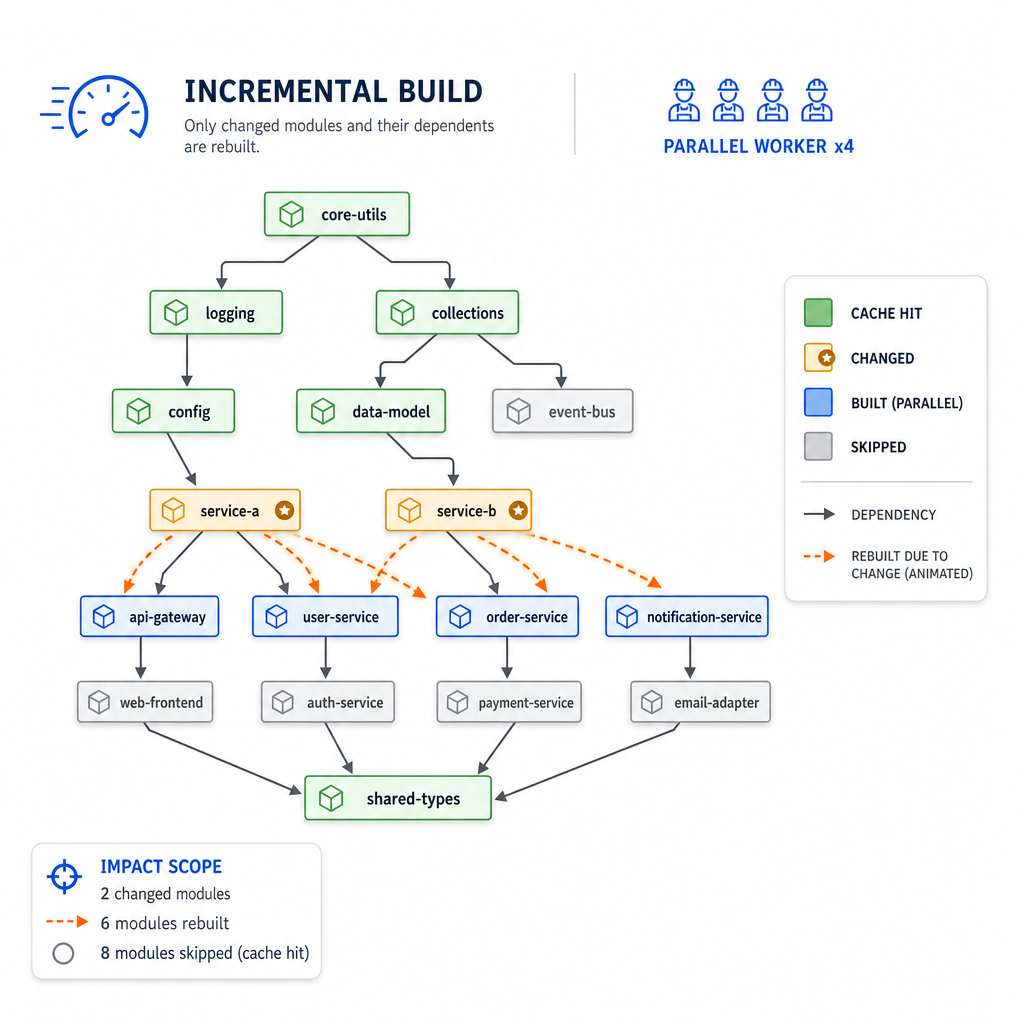
For large or monorepo projects, adopt a "ship-by-ship" strategy: migrate package-by-package with CI gating and consumer compatibility tests.
- Phase 0 — Preparation: agree on Node/TS baseline and update dev tooling.
- Phase 1 — Low-risk packages: pick leaf packages (no dependents) to convert first.
- Phase 2 — Internal libraries: migrate packages that are easy to dual-publish.
- Phase 3 — Platform & CLIs: migrate entry points last with careful canary releases.
Dual-package approaches (publish both CJS and ESM artifacts) and folder-by-folder conversion within a package reduce blast radius. Feature-flagging at runtime is rarely needed for pure module syntax changes, but can help toggle new loader behaviour in services.
Dual-publish example (package.json)
{
  "name": "your-lib",
  "version": "1.2.3",
  "main": "dist/cjs/index.js",
  "module": "dist/esm/index.js",
  "exports": {
    "./package.json": "./package.json",
    ".": {
      "import": "./dist/esm/index.js",
      "require": "./dist/cjs/index.js"
    }
  },
  "type": "module" // optional if top-level files are ESM
}
Interop patterns and common pitfalls
Mixing require() and import is the crux of many failures. Key points:
- Named export interop: importing default vs named exports from converted modules can throw. Use explicit default exports when bridging systems.
package.jsontypefield: setting"type": "module"treats.jsas ESM. Use file extensions (.cjs/.mjs) to disambiguate during transition.- Dynamic import (
await import()) is your friend for lazy-loading ESM-only modules from CJS runtime.
Tooling and build changes
Tooling is the friction point. Practical notes:
- TypeScript: set
moduletoES2020(or later) and usemoduleResolution: node16/bundlerwhere appropriate. Emit bothcjsandesmoutputs for libraries. - Babel/Rollup: configure dual outputs; Rollup excels at producing small ESM bundles.
- Test runners: Jest historically required transforms for ESM; Vitest and newer Jest versions improve native ESM support. Expect to tweak mocks and moduleNameMapper.
Troubleshooting checklist & automation tips
Automate and document common fixes:
- Run a codemod converting simple
const x = require('x')toimport x from 'x'. Usejscodeshiftorts-morphfor TypeScript-aware transforms. - Add CI job templates that run conversions on a branch, open a PR, and run full test matrix. Automate up to thousands of PRs if you have many packages.
- Common runtime errors: "Must use import to load ES Module" (fix with conditional exports or dual builds), and circular import initialization differences (refactor to break cycles).
Minimal convert example
// before (CommonJS)
const fs = require('fs');
module.exports = function read() { return fs.readFileSync('x', 'utf8'); }

// after (ESM)
import fs from 'fs';
export default function read() { return fs.readFileSync('x', 'utf8'); }
Real-world case study
A fintech monorepo (250 packages) migrated incrementally over 6 months. Strategy: automated codemods + CI PR generation. They targeted 5 leaf packages per week, created safe dual-publish artifacts, and kept a consumer compatibility test harness. Result: zero production outages attributed to the migration and an accelerated ability to ship smaller bundles to browser clients. Lessons: invest in good codemods, pick leaf nodes first, and keep a rollback publish step ready.
Conclusion — next steps and product CTA
Converting from CJS to ESM in large Node.js codebases is solvable with a structured, incremental plan. The unique angle I recommend is a "codemod + CI PR" pipeline that scales the migration, plus a ship-by-ship monorepo maturity model (levels: supported → preferred → enforced) to measure progress.
Get the complete guide with templates and checklists in our digital product: it includes jscodeshift transforms, GitHub Actions templates, package.json examples, acceptance criteria checklists, and a sample monorepo you can run locally.
Want a reproducible checklist or help writing codemods for your repo? Grab the guide and accelerate your cjs to esm migration with practical templates.
API design best practices • debugging techniques • microservices architecture


Comments
Post a Comment