Array vs List vs Vector: A Practical Complexity Guide for Python, Java, JavaScript, and C++
Understanding the complexity of collection operations is vital for developers aiming to write efficient code. Overlooking these complexities can lead to performance issues, particularly when scaling applications or transitioning between different programming languages. This guide provides a detailed analysis of time and space complexities for common collection operations across Python, Java, JavaScript, and C++.
Identifying Collection Complexity Pitfalls
Performance bottlenecks often occur because developers assume that collection operations have uniform costs across languages, which is seldom true. For instance, using a Java ArrayList for frequent insertions can degrade performance due to its dynamic resizing strategy. Similarly, JavaScript arrays can suffer inefficiencies from excessive copying and resizing as applications expand.
Real-World Example
Take an e-commerce platform maintaining a list of user actions. Using a Python list for these actions may result in O(n) time complexity for insertions at arbitrary positions due to element shifting. In such cases, employing a collections.deque, offering O(1) average-time complexity for insertions and deletions at both ends, can significantly enhance performance.
Big-O Notation: Time and Space Complexity
Big-O notation describes the upper limit of an algorithm's complexity, often focusing on the worst-case scenario. Amortized analysis presents average-time complexity over a range of operations. Understanding these concepts aids in selecting appropriate data structures.
Complexity Cheat-Sheet for Operations
Here's a quick reference for the complexity of common operations:
| Operation          | Python list | Java ArrayList | JavaScript Array | C++ vector |
|-------------------|-------------|-----------------|------------------|------------|
| Append            | O(1)        | O(1) amortized  | O(1) amortized   | O(1) amortized |
| Insert (middle)   | O(n)        | O(n)            | O(n)             | O(n)         |
| Pop (end)         | O(1)        | O(1)            | O(1)             | O(1)         |
| Random Access     | O(1)        | O(1)            | O(1)             | O(1)         |
| Iteration         | O(n)        | O(n)            | O(n)             | O(n)         |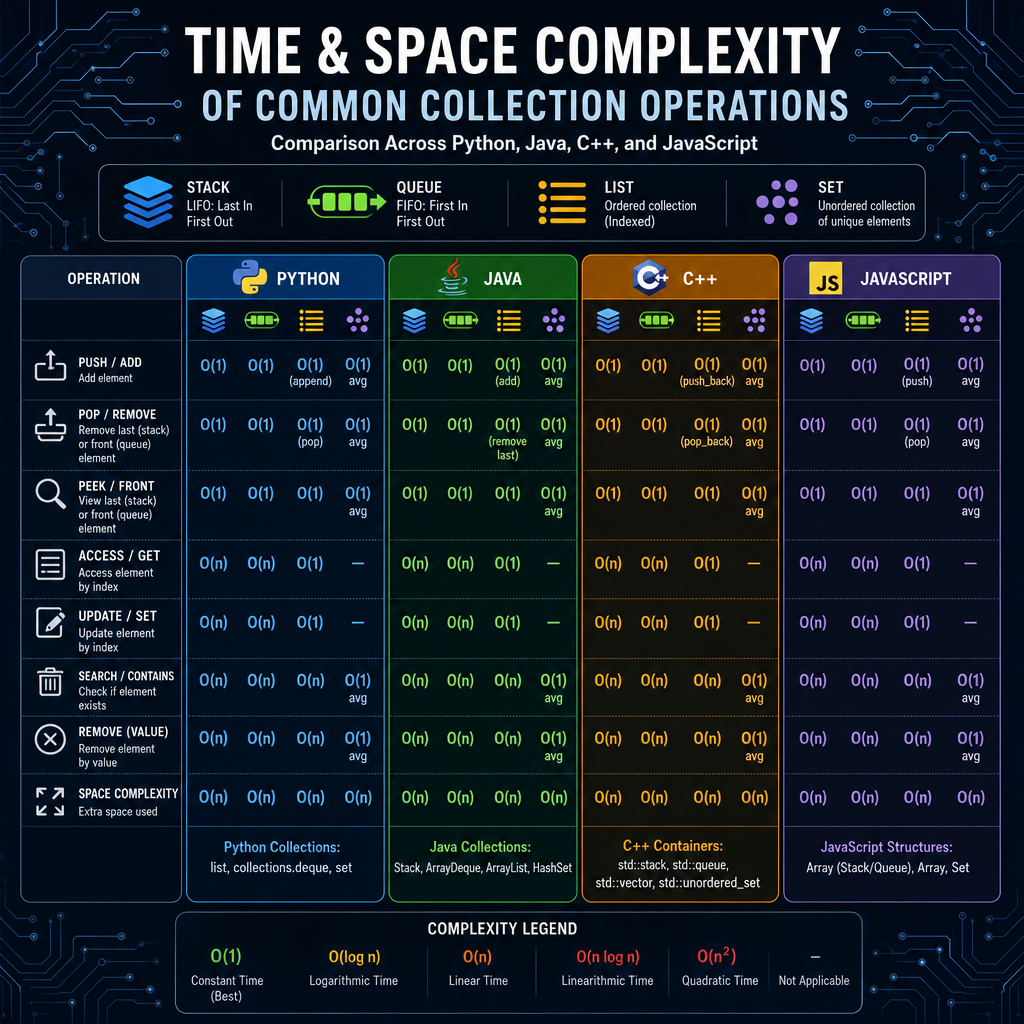
Understanding Complexity Variations
Complexity differences arise from underlying memory layouts and resizing strategies. Python lists and Java ArrayLists, for example, are dynamic arrays that resize and copy their contents when necessary, introducing overhead. C++ vectors minimize copying with a reserve strategy, optimizing capacity in advance, while JavaScript arrays rely on engine-specific optimizations.
Iterator Invalidation
Iterator invalidation can occur when collections are modified during traversal. In C++ vectors, adding elements might invalidate iterators, unlike linked lists where only iterators prior to the insertion point are affected.
Practical Usage Tips
Select the right collection based on your needs:
- If you need frequent insertions and deletions: Consider linked lists or deques.
- For efficient random access: Use arrays or vectors.
- In concurrent environments: Opt for thread-safe collections like Java's ConcurrentHashMap.
Benchmarking Performance
To gauge real-world performance, write and execute simple benchmarks. In Python, use the timeit module, while in Java, utilize JMH. For JavaScript, account for V8 optimizations using Benchmark.js. C++ developers can use Google Benchmark.
import timeit

# Python benchmark example

def benchmark_append():
    lst = []
    for i in range(10000):
        lst.append(i)

print(timeit.timeit(benchmark_append, number=100))
Migration Checklist
- When to refactor: If a collection creates inefficiencies or is expected to scale, consider replacing it with a more appropriate data structure.
- Performance debugging: Profile collections to identify hotspots and use memory profiling tools to detect unnecessary memory usage.
Conclusion
Choosing the right collection can significantly affect application performance. Always evaluate the required operations and their complexities across languages. Subscribe to CatchyBytes by Techy on YouTube for programming tutorials that delve deeper into these topics, offering clarity and insight to enhance your coding skills.


Comments
Post a Comment