Fenwick Trees Explained: Visual Intuition, Implementations, and Real-World Use Cases
For software developers dealing with frequent updates and queries of prefix sums, understanding different data structures is crucial. The Fenwick Tree, also known as the Binary Indexed Tree, is an efficient alternative to segment trees, particularly when operations like updates and prefix queries must be executed swiftly.
Why Fenwick Trees?
When programming tasks require frequent computation of prefix sums or need quick updates in arrays, naive methods like repeated summation quickly become inefficient, leading to O(n) operations. Fenwick trees offer a more efficient solution with both updates and prefix queries handled in O(log n) time. This makes them preferable over segment trees for certain scenarios, especially when space and simplicity are priorities.
Visual Intuition
At its core, a Fenwick Tree is implemented as an array where the tree structure reflects binary index breakdowns. Consider an array where each index is updated and queried according to its least significant bit (LSB). An intuitive way to visualize this is to imagine the array as layered trees, where each node aggregates sums from a subsection of the array.
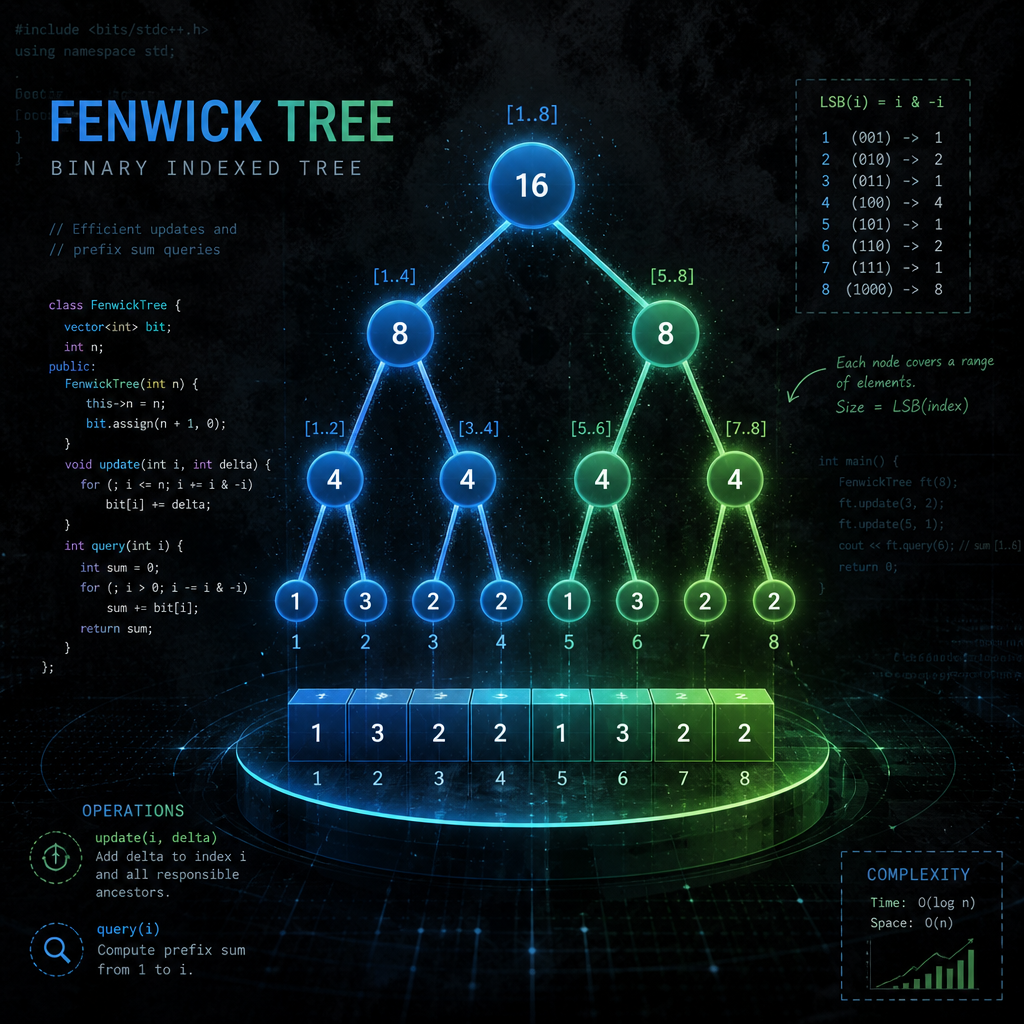
Step-by-Step Example with Diagrams
Update(index x, increment delta):
  while x <= n:
    tree[x] += delta
    x += x & (-x)

Query(index x):
  sum = 0
  while x > 0:
    sum += tree[x]
    x -= x & (-x)
  return sum
These algorithms demonstrate how the LSB is used to navigate the tree efficiently, effectively aggregating and updating sums as needed.
Core Mechanics: Index Math and LSB Operations
The operation x & (-x) computes the lowest set bit of x, helping traverse to parent indices within the tree structure. This key insight allows logarithmic navigation through the tree, applicable during both updates and queries. Understanding this bit manipulation is crucial for effectively using Fenwick Trees.
Time Complexity for Updates and Queries: O(log n)Language-Agnostic Implementations
The Fenwick Tree can be implemented across several programming languages. Below are annotated examples in Python, Java, and JavaScript:
class FenwickTree:
    def __init__(self, size):
        self.tree = [0] * (size + 1)

    def update(self, index, delta):
        while index < len(self.tree):
            self.tree[index] += delta
            index += index & (-index)

    def query(self, index):
        sum = 0
        while index > 0:
            sum += self.tree[index]
            index -= index & (-index)
        return sum
class FenwickTree {
private int[] tree;
public FenwickTree(int size) {
tree = new int[size + 1];
}
public void update(int index, int delta) {
while (index < tree.length) {
tree[index] += delta;
index += index & (-index);
}
}
public int query(int index) {
int sum = 0;
while (index > 0) {
sum += tree[index];
index -= index & (-index);
}
return sum;
}
}Variants and Extensions
Beyond the basic structure, Fenwick Trees support variants such as range update and point query. This is often achieved using the difference trick, making these data structures versatile tools in a developer’s toolkit.
Practical Tips & Real-World Use Cases
Fenwick Trees find applications in analytics systems and competitive programming, where timely prefix queries are critical. For example, they are used in real-time leaderboards where frequent score updates and fast rank retrievals are needed.
Debugging and Common Pitfalls
- Ensure correct 1-based index usage.
- Watch out for integer overflow in languages without safe bigint operations.
Testing with edge cases such as large arrays and random updates can uncover potential flaws in your Fenwick Tree implementation.
Conclusion
Fenwick Trees provide a robust solution for efficient prefix sum management in scenarios with frequent updates and queries. By understanding their mechanics and implementation, developers can optimize their applications beyond naive summation methods. To deepen your knowledge, subscribe to CatchyBytes by Techy on YouTube for more programming tutorials and insights.


Comments
Post a Comment